
September 29, 2026
A supplier clears qualification and onboarding, ships without incident for two quarters, and then a defect slips into production, and the line stops. The warning signs were usually in the data the whole time.
Either nobody was watching the right numbers, or nobody acted when those numbers moved.
Supplier performance monitoring is how quality teams can spot that drift before it reaches the floor.
But which supplier performance monitoring tools should you use, and when?
Part of our larger guide to the Supplier Lifecycle Toolkit, this article covers three core tools for monitoring supplier performance, and how they work together at different stages of the process.
See how AssurX Supplier Quality Management helps you stay on top of supplier performance across every site
Supplier KPIs
Supplier key performance indicators (KPIs) turn supplier performance into measurable, trackable numbers. Often monitored with dashboards or reports, they make trends visible early enough that a systemic issue shows up as a slope on a chart rather than a rejected lot.
Common KPIs worth tracking include on-time delivery percentage, defect rate, response time, customer complaint rate, and average days to close a corrective action. Whichever metrics you choose, they should be built with the following elements in mind:
- A clear metric definition: The metric should be specific and measurable.
- A target or threshold: This defines what success looks like, and the level that requires action.
- A measurement frequency: Some KPIs should be tracked monthly, while others might only be measured quarterly. The frequency depends on how critical the metric or component is and how quickly problems can develop.
- Visualization and reporting: Dashboards or scorecards help make changes easy to spot at a glance.
- Actionability: A number that crosses a pre-defined threshold should trigger a response.
“A KPI shouldn’t just sit on a dashboard somewhere. When the number drops below the target, that’s when you need to take action, whether that’s a discussion or escalation, or even a corrective action request,” says Stephanie Ojeda, AssurX VP of Product Management and a former quality manager herself.
KPIs help you more effectively address supplier problems, giving you hard numbers to center the conversation on. For instance, instead of saying you’ve been seeing more problems from a supplier, you can point to a defect rate that’s more than doubled from 0.5% to 1.1% over the last two quarters.
KPIs are what allow you to have data-driven conversations, but it’s important to select them carefully.
“KPIs only measure what you decide to track. So if you don’t choose your metrics well, you could end up getting a really distorted view of reality,” says Ojeda.
Supplier scorecards
A supplier scorecard is a structured report that pulls a supplier’s performance data together, typically across a quarter or a year. Where a KPI tracks one metric, a scorecard consolidates several of them into a single view, allowing you to compare suppliers against:
- Pre-defined performance criteria: A supplier who committed to 98% on-time delivery and a defect rate under 1% either met those numbers last quarter or didn’t, and the scorecard says which.
- Other suppliers: When three suppliers ship the same component, a weighted score keeps a low unit price from hiding a high defect rate.
- Industry standards: Acceptance quality limits (AQLs) vary widely by sector and by what a defect actually costs. A cosmetic flaw in a consumer product may be tolerable at a rate that would be indefensible in a safety-critical component, for instance.
Supplier scorecards are another example of how these tools make discussions with vendor partners more productive, because they allow you to highlight trends over time.
“Instead of vague feedback, you can sit down with them and show them their data. You can show them where they’re excelling, and where they need improvement. These discussions are always more effective when they’re grounded in data,” Ojeda says.
The caveat is that a scorecard is only as reliable as the quality of its inputs. Numbers pulled from inconsistent paper records or maintained in spreadsheets produce comparisons that people don’t trust when it comes to making sourcing decisions.
Risk-based incoming inspection
Inspecting 100% of incoming materials or parts isn’t feasible for most companies, which is why many manufacturers take a risk-based approach to incoming inspection. Here you want to concentrate inspection on areas of highest risk, for instance with new suppliers, critical components, or suppliers with a history of quality issues.
Risk-based incoming inspection helps protect your production line from disruption by catching defects early, and it also generates valuable data about supplier performance over time. To do it well, your program should incorporate several key elements:
- A sampling plan: This determines how much incoming material gets checked, scaled to risk. You might inspect 100% from a new supplier, versus just a fraction of that for a trusted supplier with a strong track record. Standards like ISO 2859-1 and ANSI/ASQ Z1.4 provide sampling tables that tell you how many units to pull and how many defects to accept for a given lot size.
- Clear inspection criteria: These are the standards you’re checking against, such as dimensions or labeling accuracy.
- Acceptance and rejection rules: This is where you establish how many defects or nonconformances you will tolerate before you reject the shipment.
- Documentation: Keeping records of every inspection is what lets you spot trends over time and present objective evidence to suppliers, management, and even regulators. “If it’s not documented, it didn’t happen,” says Ojeda.
- An escalation path: Here is where you determine what happens next when materials fail inspection, whether that means quarantining the shipment, notifying the supplier, or opening a supplier corrective action request (SCAR).
Supplier performance monitoring tools at a glance
Each supplier monitoring tool comes with its own strengths and limitations, which is why they work best layered together.
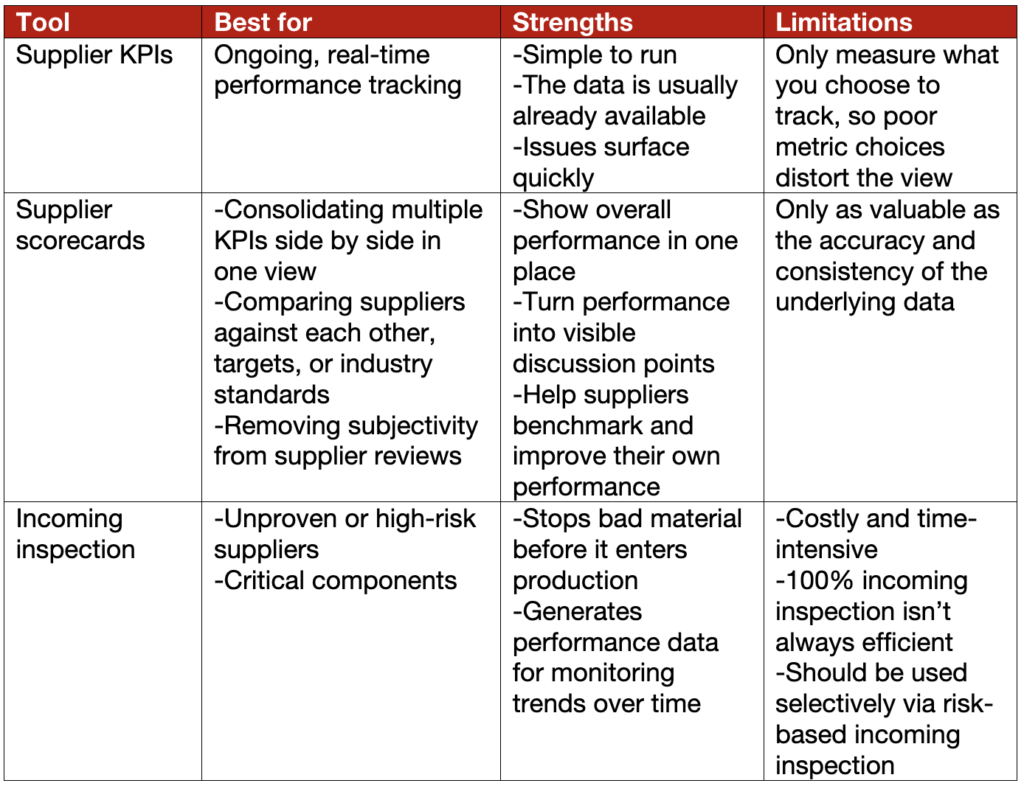
Supplier Performance Monitoring Tools at a Glance
How do you build a supplier scorecard?
Building a supplier scorecard generally includes four steps:
- Set the categories: Supplier scorecards typically incorporate metrics like quality, delivery, cost, and responsiveness.
- Select KPIs to standardize scoring in each category: Scores could be based on metrics like on-time delivery, defect rate, price stability or cost savings, and issue resolution time.
- Apply weights that reflect your priorities: Depending on your priorities and the type of material, you might determine that quality is weighted more heavily than cost, so an inexpensive supplier with defect problems can’t outscore a reliable one.
- Visualize the result and act on it: Once you build the framework, the next step is to drive transparency by putting it all on one scorecard.
Again, the quality of your data matters here.
“One way to ensure data integrity and accuracy is pulling it straight from your system of record, whether that’s your eQMS or your ERP system,” says Ojeda.
Case study: using supplier scorecards to make stronger sourcing decisions
One manufacturer relied on several suppliers for the same critical component. Performance varied widely, with some delivering on time at solid quality while others had repeated issues. Leadership had no standardized way to compare them, so they often made sourcing decisions on anecdotal feedback.
To address the issue, the team decided to build supplier scorecards to compare their vendors. By consolidating KPIs in one place, they gained a clear view of each supplier’s performance. Not only did this enable fair comparisons, but it also gave leadership the visibility they needed to make data-driven sourcing decisions.
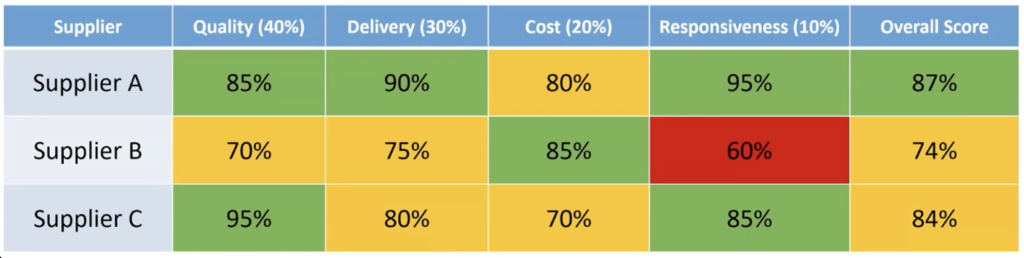
Supplier Scorecard Vendor Assessment
Here, color-coding the weighted average for each supplier makes strengths and weaknesses obvious. One supplier is strong overall, another struggles on responsiveness, and a third is strong on quality but weak on cost.
“Supplier scorecards remove subjectivity from reviews, because everyone in the room is looking at the same data. They also allow you to see your top and bottom performers so you can create targeted improvement plans,” Ojeda says.
What should happen when a supplier misses a KPI target?
The value of monitoring KPIs is in the response, and that response works best when it’s defined before you need it.
That means deciding in advance who gets the data, when it moves up a level, and what evidence supports the conversation. A connected QMS helps standardize that path by routing a missed target to the right reviewers with the supporting records attached. That means the response doesn’t depend on someone noticing a red cell in a spreadsheet.
Escalation can be more difficult when you represent a small share of a supplier’s business, or when they’re your only source. Two things change that conversation:
- Data: KPI trends, scorecard results, and inspection records help you document the pattern rather than describe it.
- Seniority: If the supplier hasn’t been entirely responsive, it might make sense to bring in someone from your organization a level or two above you on the call.
“A lot of times when you bring in that executive or that vice president or chief quality officer into the conversation, the supplier takes things a lot more seriously,” says Ojeda.
From supplier performance monitoring to auditing
Qualification sets the risk you take on. Monitoring determines how quickly you find out when that risk changes, which is why every threshold needs an action attached to it.
When the data suggests a problem is systemic rather than occasional, the next step is verifying what’s happening at the supplier’s site, whether through an onsite or remote supplier audit or a more in-depth look at the process in question.
Our next post covers supplier audits, focused process reviews, and risk-mapped checklists, including what to do when a supplier keeps passing audits while the same problems keep coming back.
Download a free brochure to learn about the AssurX EHS Incident Management Solution
About the Author
Stephanie Ojeda is Director of Product Management for the Life Sciences industry at AssurX. Stephanie brings more than 15 years of leading quality assurance functions in a variety of industries, including pharmaceutical, biotech, medical device, food & beverage, and manufacturing.