

August 26, 2026
A longtime raw-material vendor exits the market, and the clock starts ticking to replace them. The quality team needs a new source fast, but without a structured approach, the risk of choosing a supplier that doesn’t meet quality standards increases.
Avoiding this outcome requires a strong supplier qualification process, and the right tools can mean the difference between a successful partnership and a costly one.
Part of our larger guide to the Supplier Lifecycle Toolkit, this article digs into three essential supplier qualification and onboarding tools, and when to use each based on risk.
See how AssurX Supplier Quality Management connects qualification to the rest of the supplier lifecycle
The supplier qualification process at a glance
Supplier qualification is the foundation of the supplier lifecycle, where you verify capabilities and controls before a single shipment arrives.
“The goal here is simple, and that’s making sure that you only work with qualified suppliers from the start,” says Stephanie Ojeda, AssurX VP of Product Management.
Qualification is also the highest-leverage stage in supplier quality, because the decisions you make here impact every stage that follows.
Steps in the supplier qualification process include:
- Assess risk: Decide whether a supplier needs a quick screen or deeper qualification.
- Screen with a supplier questionnaire: Gather a baseline for each supplier to quickly filter out those who don’t qualify.
- Validate capability with evidence: Use tools like production part approval process (PPAP) and advanced product quality planning (APQP) to document evidence of capability for high-stakes parts and applications.
- Conduct site visits or audits: Move to in-person verification when earlier steps raise a red flag or the supplier’s risk level warrants a closer look.
- Lock in a quality agreement: Define responsibilities, standards, and change control to put expectations in writing up front.
- Make the go/no-go call: Hold an internal review and document the decision so you have a complete record of your rationale should leadership or regulators need to review it.
The key throughout the process is to align the depth of qualification with each supplier’s risk. For example, you might require documented capability evidence before you approve a first order from a critical raw-material supplier. A low-risk indirect supplier, on the other hand, may need only a completed questionnaire on file.
With that in mind, let’s jump into the tools themselves.
Supplier questionnaires
A supplier questionnaire is a structured survey designed to capture key information about your suppliers, like certifications and capabilities.
Supplier questionnaires are especially useful early in the qualification phase because they provide a standardized, cost-effective way to screen many suppliers and narrow down the pool before you commit resources to site visits and audits.
A well-structured supplier questionnaire also provides visibility into risk by allowing you to identify potential problems before you start working together. The drawback is that your supplier is filling this out themselves, so it won’t always uncover deeper risks.
That said, they are a nearly universal tool used across industries and every tier of supplier risk.
“Whenever I’ve managed supplier quality, supplier questionnaires have always been part of my process,” says Ojeda.
How do you build a supplier questionnaire?
The questionnaire is the tool you’ll reach for most, so it’s worth building with care. The process centers broadly on five steps:
- Define the purpose: Decide whether the questionnaire is a quick screen or a deeper prequalification. The answer depends on the risk tier of the supplier, as critical materials need more scrutiny than non-critical parts. Also consider the specific risks you’re trying to mitigate when you define the purpose.
- Decide which categories to capture: A few buckets show up on almost every questionnaire:
- Certifications
- Capabilities and capacity
- Quality system maturity
- Change management procedures
- Draft the questions: Some can be closed-ended, like asking a supplier to provide an ISO 9001 or ISO 13485 certificate number. “Other questions should invite explanation, like asking them to describe their quality culture and how they’ve implemented it across the organization,” says Ojeda.
- Set transparent scoring: Define each category’s weight based on the supplier and the criticality of parts. Set clear must-haves up front, such as automatically disqualifying suppliers without a required certification.
- Run the process: Send the questionnaire with a clear deadline. Once it comes back from the supplier, hold a quick review with internal stakeholders to decide whether to move forward. For higher-risk suppliers, the questionnaire may end up triggering an audit.
Red flags to watch for in supplier questionnaires
When you review completed supplier questionnaires, there are several red flags to watch for that warrant disqualification, including:
- Regulatory findings
- Lack of formalized processes around corrective and preventive action (CAPA), inspections, or nonconforming product
- Suppliers that can’t describe processes in their own words
- Lack of data, for instance if they can’t tell you the number of CAPAs they had in the past quarter and how they addressed them
- Insufficient traceability
- No quality manual
When following up on questionnaires, it’s also worth asking informal questions about the quality department to gauge whether turnover is an issue.
“High turnover in quality is a big red flag. Constant rotation of quality leadership usually means the quality team isn’t getting support from the top,” says Ojeda.
PPAP and APQP
For critical parts or high-consequence applications where a supplier questionnaire isn’t enough, manufacturers typically rely on two specific tools to document capability: PPAP and APQP.
The table below provides a brief comparison:
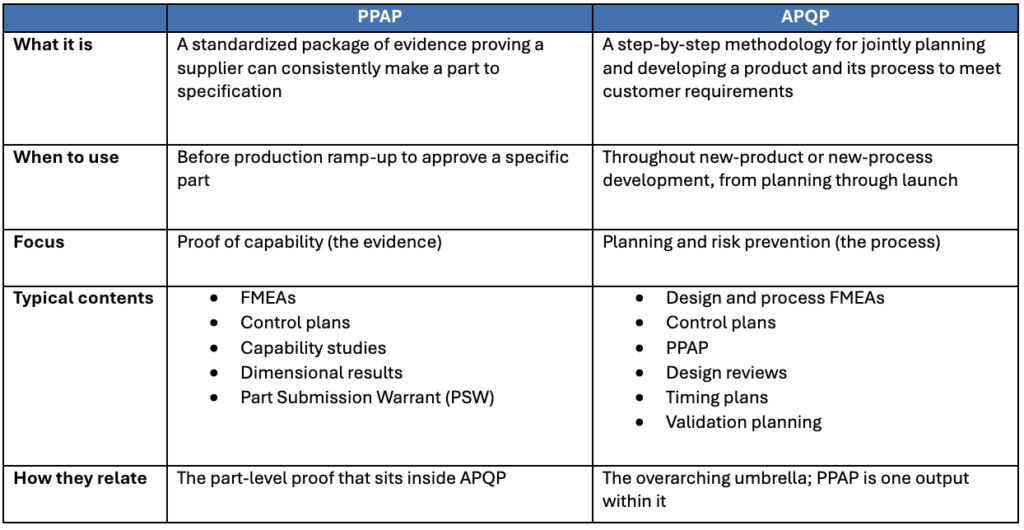
PPAP and APQP Tools Comparison Chart
The real power of these tools lies in their structure, giving you proven assurance of the supplier’s capability.
“You’re not just taking their word for it. You have that concrete evidence that they can actually do what they say they’re going to do,” Ojeda says.
The tradeoff is effort. APQP and PPAP take time, resources, and a lot of supplier maturity to do well. As such, these tools might not be the best choice for an early-stage supplier, startup, or smaller company.
Supplier quality agreements
A supplier quality agreement is a formal written contract that defines responsibilities and expectations on both sides of the relationship. Supplier quality agreements should cover:
- Quality standards and specifications the supplier must meet
- Change control procedures
- Notification and escalation requirements
- Audit rights and access to records
Of these elements, confirming the supplier has a structured change control process is the most important. Here you want to see three things:
- The documented process itself: The supplier should have an SOP that documents what happens when they change a product, process, or documentation. This should clearly spell out who the stakeholders are and how they analyze the impact and risk of the change.
- Evidence of adherence: Ask for documentation from the last time they introduced a product or made a major change.
- The ability to speak to the process naturally: “The supplier should be able to talk through the change control process naturally, not just read the SOP. A good auditor can see through documentation that exists only as a checkbox,” Ojeda says.
It’s also worth considering how your organization handles change notifications. If a change notification lands in an inbox and somehow gets missed, the change may reach your line before anyone assesses its impact on the product. A controlled change control workflow in the QMS closes that gap, routing every supplier change to the right reviewers and documenting the decision.
Which qualification tools should you use for each supplier?
Each supplier qualification tool fits a different situation and has its own strengths and limitations, as outlined in the table below.
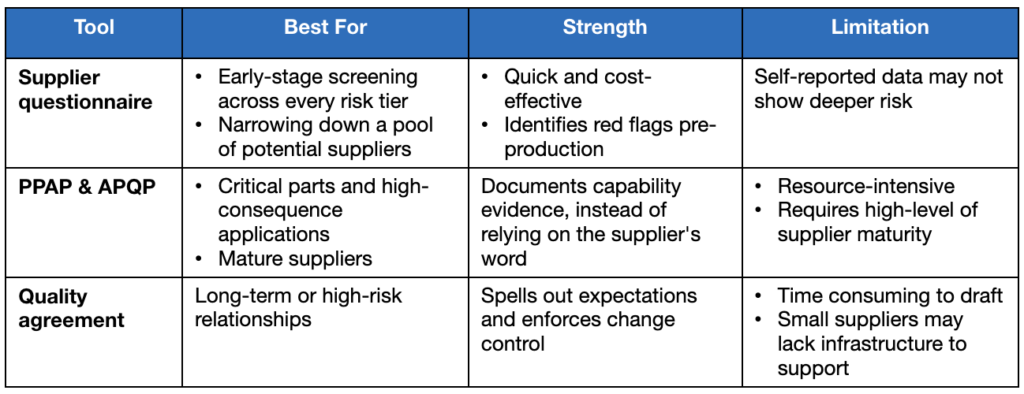
Supplier Qualification Strengths and Limitations Chart
Should your quality agreement include incentives or penalties?
People often ask whether a quality agreement needs incentives for good behavior or penalties for missed commitments. The short answer is no.
“If you’re doing that onboarding stage correctly and you’re choosing from a good pool of suppliers that know how to meet deadlines, you really shouldn’t need incentives or any kind of punishment,” Ojeda says.
A more effective approach is to make sure suppliers know you’re paying attention. Actively monitoring supplier data, conducting regular site visits, and addressing issues as they come up communicate to suppliers large and small that quality issues won’t be ignored.
Supplier qualification determines downstream quality risk
The supplier qualification process dictates how much supplier risk you carry downstream. Match the tool to the risk, and monitoring, auditing, and improvement all get easier.
“None of this is about which tool is the best overall. It’s about which one fits the situation you’re facing,” says Ojeda.
Once a qualified supplier is in the door, the next stage is confirming they keep meeting expectations. Our next post moves into monitoring, where tools like an effective supplier scorecard can help you turn that initial confidence into measurable performance.
Stephanie Ojeda is Vice President of Product Management for the Life Sciences industry at AssurX. Stephanie brings more than 18 years of leading quality assurance functions in a variety of industries, including pharmaceutical, biotech, medical device, food & beverage, and manufacturing.