
August 5, 2026
A quality team’s supplier toolbox is deep. Supplier questionnaires, PPAP, supplier scorecards, incoming inspection, audits, corrective action—the list goes on.
In my years of experience as a quality leader, the challenge I see is matching each one to the right stage in the supplier process and the right level of risk.
In this series overview, we explore key tools to consider at each stage of the supplier quality lifecycle, including onboarding, monitoring, auditing, and improvement. Each installment that follows will go deeper on each stage’s tools and how to apply them.
Along the way, we’ll look at how coordinating each of these phases helps transform the relationship from policing suppliers to partnering with them on problem-solving.
See how AssurX Supplier Quality Management software connects every stage of the supplier quality lifecycle
What are the stages of the supplier quality lifecycle?
Supplier quality management works best when you manage it as a structured process. Each stage sets up the next:
- Onboarding and qualification is about establishing the baseline so that you only let qualified suppliers into your system.
- Performance monitoring ensures you’re watching to see that suppliers keep meeting expectations once they’re in.
- Auditing and assessment are where you validate that what a supplier says matches what’s actually happening.
- Corrective action and improvement allow you to contain problems, address true root causes, and build supplier capability.
- Data and governance are essential throughout for keeping centralized, traceable records and decisions that hold up under audit.
All of these stages have their own set of supplier quality tools with specific use cases, strengths, and limitations. Over time, the data you gather allows you to have more productive conversations with suppliers that are focused on facts rather than finger-pointing.
Onboarding: prove supplier capability before you commit
Onboarding sets the foundation, and getting this stage right will eliminate a lot of headaches down the road. Improving your selection process ensures you’re pulling from a stronger set of suppliers, reducing the need for enforcement or incentives.
Three tools do the heavy lifting here, each suited to a different level of supplier risk:
- Supplier questionnaires give you a fast, standardized way to screen many suppliers and highlight red flags before production. The tradeoff is that the data is self-reported, so on its own it won’t surface deeper risk.
- PPAP and APQP prove capability with documented evidence for critical parts. PPAP (Production Part Approval Process) confirms a supplier can deliver to spec, while APQP (Advanced Product Quality Planning) is the broader planning framework. Both take effort and supplier maturity, so manufacturers tend to use them for critical components rather than early-stage or small suppliers.
- Quality agreements lock in responsibilities, standards, and change control and notification mechanisms. The limitation here is that they take time to draft, and smaller suppliers may lack the infrastructure to support one.
Monitoring: from initial confidence to measurable performance
Once a supplier is in, monitoring is key to continued confidence and proactive risk mitigation. Three tools in particular here are helpful for monitoring ongoing performance:
- KPIs make supplier performance visible via trackable metrics like on-time delivery, defect rate, response time, complaint rate, or days to close a corrective action. That lets you tell a supplier, for instance, that their on-time delivery slipped from 98% to 90% over three quarters, instead of just saying deliveries have been late. The limitation is that you only measure what you choose to track, which can provide a distorted view of reality.
- Supplier scorecards consolidate those KPIs side by side in one view so you can compare suppliers against each other, a target, or even a standard. This allows you to have better conversations with suppliers backed by data, and helps suppliers benchmark their own performance for improvement.
- Risk-based incoming inspection checks material on arrival, using a sampling plan based on where risk is highest instead of on every shipment. A strong incoming inspection program must have clear inspection criteria, acceptance/rejection rules, and an escalation path for when materials fail inspection. The downside of relying on inspection is that it’s costly and not always efficient at finding problems, which is why you should use a risk-based approach.
Note that for monitoring to be effective, it must be followed by action. That means when a number crosses a specific threshold, it should trigger a conversation, an escalation, or a corrective action request.
Auditing: verify suppliers do what they say
Supplier audits go a level deeper than monitoring by confirming a supplier’s process holds up under scrutiny. The correct auditing tool for the situation depends on how broad or targeted the question is:
- Supplier audits evaluate a supplier against defined criteria to validate compliance across many processes, like confirming a CAPA closed six months ago actually held. Their strength is their scope and regulatory confidence, but the limitations are that they do take time and resources, especially if you’re doing onsite audits. In addition, they only work if your audit criteria are well designed.
- Focused process reviews zero in on one high-risk or quality-critical process, and are useful for identifying root causes and bottlenecks. They give you a detailed look at one area, but by definition are narrow in scope and may miss problems in other areas.
- Risk-mapped checklists take a standard checklist and align it with a supplier’s unique risk profile. This provides transparency and consistency in how you treat risk, but requires upfront work to build out the risk analysis.
Improvement: where most supplier quality programs stall
This is the stage where I’ve seen quality teams struggle most. That’s because getting suppliers in the door is easy compared with building the capability that prevents issues (and their recurrence) in the long term.
Three tools are core to this stage of the lifecycle:
- Containment puts a temporary fence around the problem to protect production and customers while the permanent fix takes shape. While containment helps limit the impact of problems via steps like quarantining and sorting, it doesn’t fix the problem on its own.
- A SCAR (Supplier Corrective Action Request) asks a supplier to investigate the root cause of a problem and propose actions to correct the issue and prevent it from happening again. SCARs provide a structured process and accountability, but their limitation is that they are inherently reactive, kicking in only after a problem has occurred.
- Supplier development and continuous improvement build supplier capability through workshops, training, and joint projects, such as a Kaizen event run with the supplier. This proactive approach can help transform supplier relationships into truly collaborative partnerships, but takes real time and commitment from both sides.
A supplier quality tool selection matrix
No single tool covers the whole lifecycle, so the practical question is which one to reach for, and when. The matrix below provides a quick reference for which tools are useful for different scenarios and levels of supplier risk.
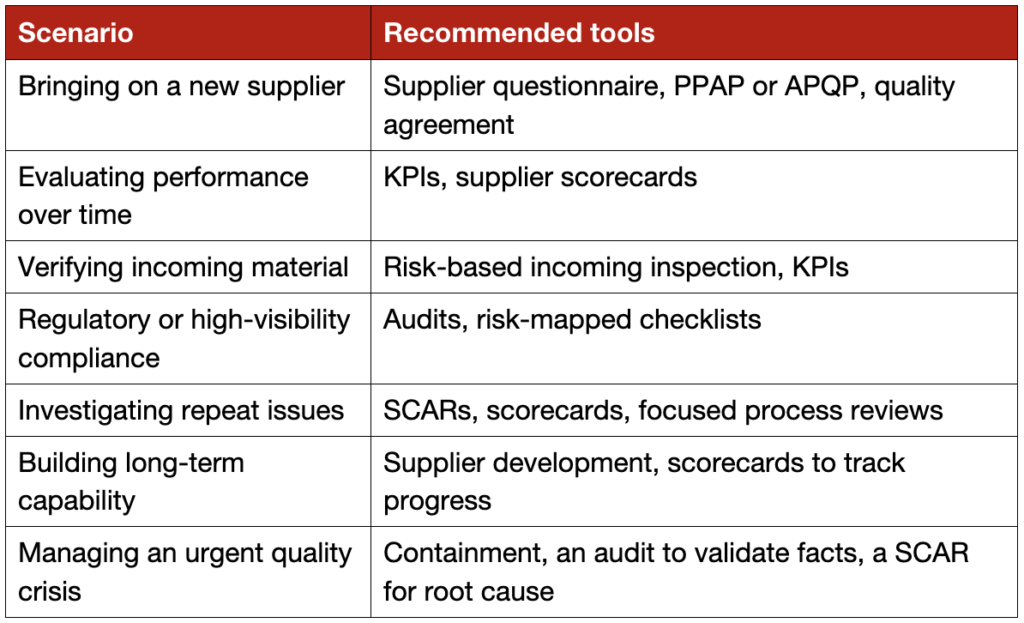
Supplier Quality Tool Reference Chart
The real value comes from connecting these different tools across the QMS in one closed-loop platform.
One global pharmaceutical and chemical manufacturer, for instance, integrated supplier defect management into the QMS so that when raw-material or packaging defects are logged, the supplier or subcontractor details automatically populate from the ERP. From there, follow-up tasks are automatically generated in the system based on the specific defect type, allowing them to standardize defect handling while gaining a single source of truth for all supplier quality data.
The takeaway is that when issues like defects link straight back to the supplier record, it helps manufacturers:
- Track issues more effectively to closure to reduce cost of poor quality (CoPQ).
- See the bigger picture in terms of supplier performance trends and improvement opportunities.
- Ensure audit-ready traceability and consistent decision-making.
Where supplier quality becomes a competitive advantage
No single supplier quality tool is enough on its own. The key is understanding which is most appropriate to the situation and the supplier. Having all of them linked in a centralized QMS is what turns data scattered across inboxes and spreadsheets into a unified picture of supplier performance and risk.
Companies also find that when data flows cleanly from qualification through improvement, the relationship changes. Suppliers stop being another checkpoint and start becoming true partners in the process. That shift is what turns supplier quality from a compliance cost into a competitive advantage.
About the Author
Stephanie Ojeda is Vice President of Product Management for the Life Sciences industry at AssurX. Stephanie brings more than 18 years of leading quality assurance functions in a variety of industries, including pharmaceutical, biotech, medical device, food & beverage, and manufacturing.